Archive

XBee LilyPad First Prototype

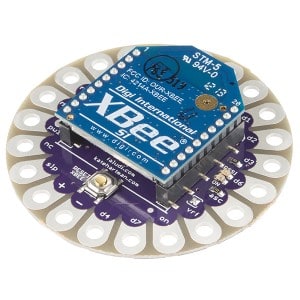
The first prototype of the XBee LilyPad open-source wearable radio has arrived and is working properly. All the lights turn on, the connections are just great and getting a proto in hand has spawned all kinds of new ideas. The push for the next version is to move all the components out from under the XBee so that it can sit flush to the board, making the LilyPad thinner if it is soldered directly on. We’re also going to add a voltage regulator so the board can be used with a 5 Volt supply if desired. Headers for programming the XBee and a single jumper to control the debugging LEDs will add useful flexibility. Thanks to Tom Igoe and Zach Eveland for their helpful suggestions.

The prototype with female headers:

Zach performs a wearability test with the help of scotch tape:

7 in 7 Wrap-up

7 in 7 is now a fond memory, so the participants got together and did a little post-mortem evaluation on the scheme. The week was clearly an overall success. Everyone felt that 7 in 7 got their creative juices moving and provided motivation to attack projects that in some cases had sat on the to-do list for months or even years. Things got done.

Even so, there’s room for improvement. The universal feeling was that seven days is an unwieldy length of time. It was impractical to put everything else in our lives on hold for that long. Five days, or as little as three would be much easier to manage, and improve our ability to focus on the creative tasks at hand. A shorter timeframe would also create a more cohesive group, so that everyone could attend kick-off meetings, sanity breaks and a celebratory completion party. Managing the pressure to produce came up several times. Several people commented that while the social motivation was excellent, they sometimes felt intimidated by the visibility. Keeping things inspirational and stimulating while maintaining a supportive and informal environment is clearly the balance to strike for success.

Other advice was to avoid embarking on a big project or doing too many things you didn’t know how to do already. Reserving some minimal time each day for attending to other tasks, remembering that documentation can take a significant chunk of time at the end and making sure that you’re comfortable making the project public were all suggested.

Some great ideas came out of our wrap-up meeting including:

  • doing a swap where everyone works on someone else’s project for an hour or two
  • having a common creative warm-up exercise each day
  • planning for documentation, and having extra help around to accomplish it
  • having help running the event from people who aren’t currently busy participating
  • keeping fresh by repeating this event on a regular basis

We’ll definitely keep these ideas in mind for next time, which might be a 3 in 3 sometime in August or September. In the meantime, several of the one-day projects have inspired interesting larger ventures. I’m personally excited about trying this all again, with fresh new faces added to the mix.

Blog: 7 in 7 Days: 1 2 3 4 5 6 7

XBee LilyPad Second Draft

This is a second draft of the XBee LilyPad that Kate and I are working on. It adds some noise filtering and decoupling capacitors to help with reliability. We’ve also added LED outputs so users can tell if the XBee is on, associated and receiving information. There’s currently solder jumpers on these lights, so that they can be disconnected if the blinking isn’t appropriate for the project, or if those pins need to be used for something else. Here’s an enlarged view.

A third draft will be done after a couple electrical engineer friends have contributed their wisdom, then it’s off to the circuit printers for an initial prototype.

MatchPort Breakout Board

I created a breakout board for the Lantronix MatchPort embedded WiFi module a while back and didn’t get around to posting the board files. The breakout board is needed to go from the 2 mm pins on the module to the 0.1 inch pin spacing on a solderless breadboard. I recommend using female headers to mount the MatchPort, rather than soldering it in permanently. Use Eagle to output Gerber files for manufacturing the MatchPort breakout board v1.02.

Vegan Pork Martini

Let’s talk about Josh Karpf. Josh and I both went to Oberlin, where we did our undergrad. The majority of my memories of him are of his flyaway Warholesque hair and a minority are about the unusual objects he kept in a pencil cup. Anyway, a number of years after we graduated I was perusing the still-nascent web and stumbled across a “site-of-the-day” depicting martinis made from meat. It was linked to from everywhere which was possible then because the Internet was still pretty small. Something seemed familiar, and then the realization flashed on me that I knew the guy who had done this. It was Josh, the dude with that hair, and it turns out his carnivore’s cocktail had taken the 1997 Internet by storm. Within a week or two it was all over the web’s list of weird, strange, new, looney, worst and best sites. The pork martini was a meme and by chance, I was on a first name basis with the source. Josh has since updated the site with new pictures and a somewhat more modern look. The other white meat martini lives on.

In the days and years that passed, when martinis or pork come up on conversation I often find myself defending Josh’s explorations to those who would close their mind to a martini made of meat. I encourage them to consider a trial swig but usually they defer. Naturally, a few of my friends get a free pass. They’re vegans, so tasting a pork martini is out of the question.

Until now.

Presenting an animal-free homage to Josh’s porcine concoction, devised as my last day-long project of 7 in 7. He’s a rabid carnivore so I doubt we’d ever get his full endorsement, but adventerous vegetarians and vegans can now quaff a meat-like drink without fear of sullying their fauna-free repasts. I give you the Vegan Pork Martini:


The Source


Ingredients


Infusion


The Meatless Pork Martini, BBQ Pork and Bacon Strip varieties


Bold Tasters

Kudos to the May Wah Market on Hester Street for their Vegan BBQ Pork and Vegan Bacon strips, to Gabe and Kate for tasting, and to Josh Karpf for the original inspiration and his lifelong commitment to all things meat.

XBee LilyPad

We work with the LilyPad open-source wearables system and the XBee radios a lot at ITP, so Kate Hartman and I decided that it was time to put the two together. My Friday 7 in 7 project was to create a XBee LilyPad board, the first draft of which is pictured above. There’s probably going to be a second draft before we have the printed circuit boards made, adding some decoupling capacitors and possibly a few output LEDs. I’d like to keep things pretty bare bones and just see how people might use them before adding complexity like sensors or independent power. We’re planning to run some tests on the prototypes to evaluate wearability and integration methods. The XBee can transmit information from an Arduino module, but also has some ability to function independently. There’s eight pins of input and output, including analog transmissions, that can be used without a microcontroller. Therefore it makes sense to think about another iteration with integrated battery power.

When the board files are done, they’ll be posted publicly on my site (under Projects) and can be used by anyone under a Creative Commons open-source license. A couple of my Sociable Objects students working on socially shape-shifting skirts. Hopefully the new XBee LilyPad will enable their creations.

Desktop Flight Tracker

My friends and family are always coming and going. I sometimes follow their flights, especially when they are showing up at my door, or departing on a life-expanding adventure. It’s easy to do if I stay in front of the computer with a web page open. However, when I’m at the computer I’m usually working on something else that gets in the way, and away from the screen there’s no information at all.

For today’s 7 in 7 project I created a Desktop Flight Tracker that physically indicates the altitude of a live aircraft flight from online data. The system includes an Arduino microcontroller with embedded Internet connection and a small servo motor attached to a model jet airliner. Once the airline name and flight number is loaded into the system, the model jet rises off the desktop just as the real flight takes off. The model continues to rise as the actual plane climbs to its cruising altitude, then holds its position. (I like to imagine that tiny cocktails are being served inside.) For descent and landing, the model lowers itself to the desktop, just as the real flight touches down at its destination. Please keep your seatbelts fastened until the aircraft has come to a full stop at the gate.

In the hour or so since I got the prototype working properly, I’ve tracked a couple flights as they cruised into the New York area, descended and touched down at JFK—both informative and entertaining. Bon voyage!

Open-source Arduino Clock Project

There’s plenty of clock projects that use the open-source Arduino microcontroller platform, but to my knowledge, none of those projects are themselves officially open-source. So as a quick one-day project for 7 in 7, I started creating clock code that anyone can use and extend for their own projects, under the GPL Creative Commons license. So far it’s simply code for tracking weekday and time in a cyclical pattern, along with some buttons to set the clock. There’s plenty of room for creative additions, and that’s just the point. Use the Open-source Arduino Clock code as a base to create something amazing!

Clam-flavored Gum

I really don’t know why, but in college my good friend Dan became obsessed with clam gum. An odd obsession of course because clam gum didn”t exist. I guess he just thought it would be funny if it did.

As of today, Clam Gum is real. For my 7 in 7 project I hacked a chewing gum-making kit with clam juice and created a chompable concoction with a maritime tang. It’s weird and absolutely nobody here will put it in their mouth.


Proximity Maintenance Device

For my first 7 in 7 project I created a prototype for a proximity maintenance device. This is a radio-enabled bracelet or necklace worn by two individuals who do not want to become separated in a crowd. As long as the devices can maintain radio contact, nothing happens. However if the individuals move far enough apart or lose radio contact, their devices begin vibrating. At this point they can seek each other out and reunite.

The prototype I made uses XBee radios paired with Arduino microcontrollers to manage the radio messages and produce the alerts. The challenge of a 7 in 7 project is to complete it in 24 hours, therefore these devices are still in a fairly rough state. Luckily they are fully operational and can easily be worn outside for real-world testing. Thanks to Kate for helping with a quickie sleeve mount and cool sealed vibrator motors with magnetic mounting snaps. One project down, six to go!